
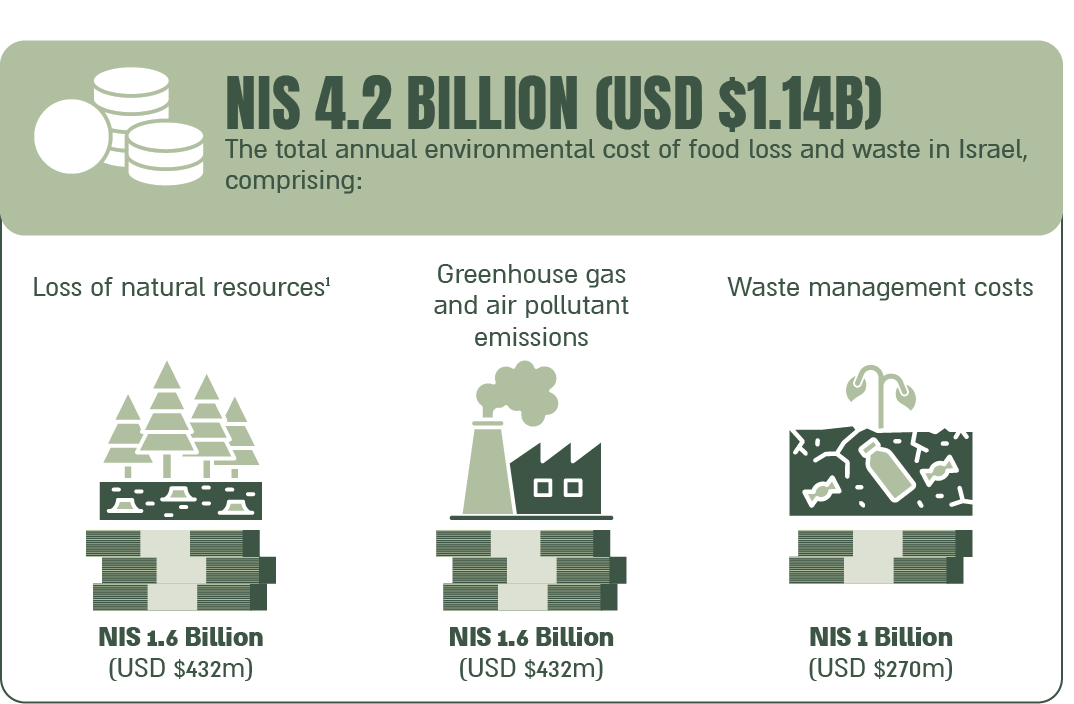
NIS 4.2 Billion (USD $1.14b)
The total annual environmental cost of food loss and waste in Israel
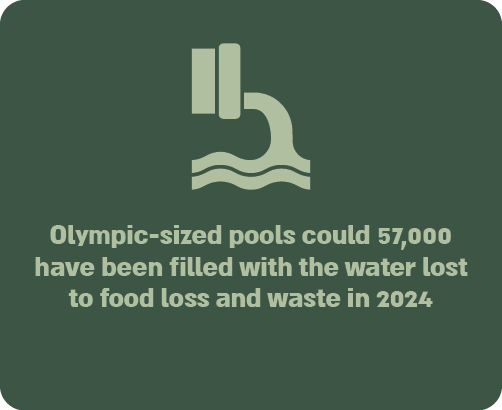
57,000 Olympic-sized pools could have been filled with the water lost to food loss and waste in 2024
Environmental Impacts and Costs of Food Loss and Waste in Israel
Food production relies on a broad range of resources—land, water, fertilizers, chemicals, and energy—and accounts for nearly one-fifth of global greenhouse gas emissions[1]. Many of these resources are non-renewable,[2] and their intensive use poses serious risks to water sources, soil health, air quality, and biodiversity worldwide.
In 2024, the environmental cost of lost food in Israel is estimated at approximately NIS 4.2b (USD $1.14b). This includes about NIS 1.6b (USD $432m) resulting from the unnecessary depletion of land and water resources, NIS 1.6b (USD $432m) from greenhouse gas and air pollutant emissions, and NIS 1b (USD $270m) in direct waste treatment costs. Across the various stages of the food supply chain (excluding the agricultural sector), food loss and waste generates an estimated 2m tons of municipal waste (including packaging), representing roughly 35% of Israel’s total municipal waste. It is important to note that this is a conservative estimate, which does not account for environmental costs incurred outside Israel’s borders, or for additional environmental impacts, such as loss of biodiversity.
Although food production has well-documented environmental drawbacks, agriculture is generally not regarded as a polluting sector and is rarely subject to environmental taxes or levies. This is largely because the positive externalities of food consumption are considered to outweigh the negative externalities of its production. In many developed countries, food production and consumption are even supported through direct or indirect subsidies.
However, food loss and waste, defined as food that is produced but not consumed, carry all the environmental costs of production, handling, and disposal, without delivering any of the benefits associated with consumption. As such, food loss and waste represent a pure environmental burden.
Global recognition of the environmental consequences of food loss and waste has grown significantly in recent years. The FAO and the United Nations Environment Programme (UNEP) are jointly promoting a standardized international metric for measuring the scale of food loss and waste, under the Sustainable Development Goals (SDG) framework. In 2019, UNEP published the Food Waste Index Report, which for the first time underscored the environmental dimensions of food loss and waste and highlighted the importance of using life cycle assessment methodologies to quantify environmental impacts throughout the value chain. This momentum continued in 2023, when the FAO released its State of Food and Agriculture (SOFA) Report, focusing on the environmental impacts of food loss during the agricultural production and processing stages. The report estimates that losses at these stages alone result in approximately 2.5 gigatons of CO₂-equivalent emissions per year, illustrating the significant role of food loss in driving global warming. The FAO emphasizes that reducing food loss and waste is one of the most effective strategies for cutting greenhouse gas emissions, preserving land and water resources, and easing pressure on ecosystems.
Efforts to reduce food loss can take many forms, ranging from measures that prevent surplus at the source to policies that promote food recovery and redistribution and strategies that prioritize composting and anaerobic digestion over landfilling. In this context, governments worldwide are employing a variety of policy tools aimed at minimizing food loss and waste.
This section examines the environmental costs of food loss and waste in Israel, with a focus on impacts in 2024. The analysis addresses greenhouse gas and air pollutant emissions across the food production, consumption, and disposal chain, the loss of natural resources, particularly land and water, and the environmental burdens associated with waste treatment. The external costs of emissions were calculated using the methodology developed by the FAO.[3] However, other environmental externalities, such as the impact on water and soil quality and biodiversity loss, were not included in this stage of the analysis. Therefore, the environmental cost assessment presented here is a partial estimate and serves as a basis for a more comprehensive environmental cost evaluation of food loss and waste in Israel in the coming years.
It is important to note that the estimates presented here only pertain to environmental impacts occurring within Israel’s geographic borders. They do not account for the natural resources used or emissions generated during the cultivation and production of food outside the country. This is a critical distinction, as Israel relies heavily on food imports, particularly in categories such as grains, sugars, oils, and fish. Currently, an estimated 80% of calories in the Israeli diet come from imported sources, whether through direct imports of food products or through animal-based products fed on imported feed.[4] Certain food categories, such as grains and meat, have particularly high import ratios relative to national consumption. Accordingly, the full environmental impact of food discarded in Israel is greater than what is captured here.
[1] http://www.fao.org/economic/ess/environment/data/emission-shares/en/
[2] Cut Waste, GROW PROFIT. How to reduce and manage food waste, leading to increased profitability and environmental sustainability, Background Paper 2012
[3] FAO, Food Waste Footprint Full Cost Accounting, 2014
[4] Policy Paper | The Climate Crisis and Our Plate, Dr. Liron Amdor
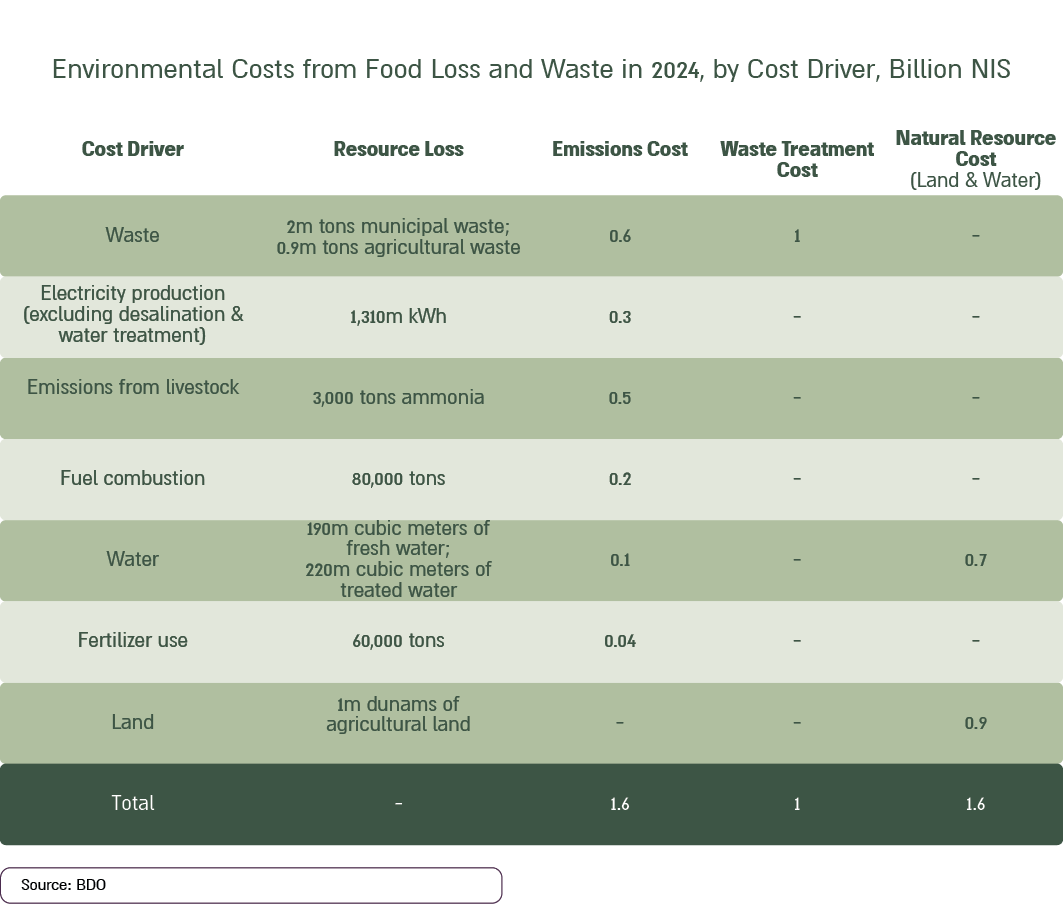
The environmental impacts of food production, spanning cultivation, processing, marketing, consumption, and disposal, are largely driven by energy use and resource demands, and vary significantly by crop type. These impacts are compounded by the additional economic and environmental costs of managing discarded food and packaging waste.
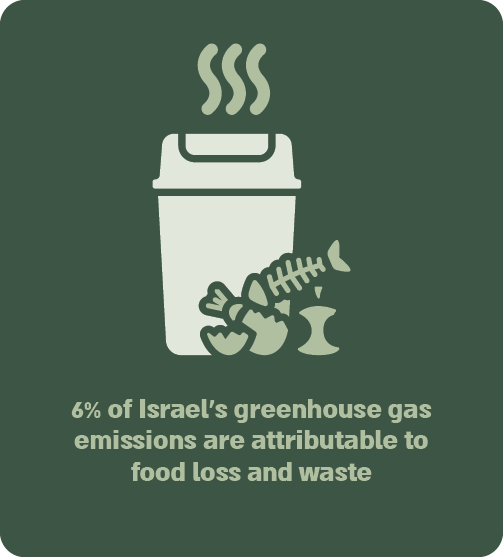
Beyond the direct environmental costs, food lost and waste in Israel in 2024 also resulted in significant resource losses. These included 1,310m kilowatt-hours of electricity—roughly equivalent to the annual energy used to produce all electronic and electrical devices in Israel, and 80,000 tons of fuel, enough to power around 175,000 cars for a year. In addition, 190m cubic meters of freshwater were lost, enough to fill 57,000 Olympic-sized swimming pools, along with 220m cubic meters of reclaimed wastewater. The loss of approximately 1m dunams of agricultural land, an area equivalent to 20 times the size of Tel Aviv, further highlights the scale of the issue. Other losses included 180,000 tons of packaging waste, more than 60,000 tons of fertilizers, and about 3,000 tons of ammonia emissions from livestock. Together, these factors contributed to around 5m tons of greenhouse gas emissions in 2024, representing roughly 6% of Israel’s total emissions.[1] Under Government Decision No. 171, issued on July 25, 2021, regarding transitioning to a low-carbon economy,[2] Israel is committed to reducing greenhouse gas emissions by 30% by 2030 and 85% by 2050, relative to 2015 levels. Additionally, in October 2021, the Prime Minister announced a national goal of reaching net-zero carbon emissions by 2050.[3]
To support these national targets, the Israeli government set sector-specific goals in the same decision, aimed at reducing greenhouse gas emissions and increasing energy efficiency across the economy. These include reducing emissions from solid waste by at least 47% by 2030, compared to 2015 levels; cutting emissions from municipal waste by at least 92% by 2050, relative to the 2015 baseline of 5.5m tons; and decreasing the volume of landfilled municipal waste by 71% by 2030, compared to 4.5m tons in 2018. Reducing food waste in Israel will play a key role in supporting the national effort to meet greenhouse gas reduction targets and reduce municipal waste landfill rates.
On December 3, 2024, the Knesset’s Interior and Environmental Protection Committee approved the Climate Bill for its second and third readings, subject to revision. In its current form, the bill sets a national target of a 27% reduction in greenhouse gas emissions by 2030, and net-zero emissions by 2050. The proposed legislation must now be reapproved by the Ministerial Committee for Legislation, returned to the Interior and Environmental Protection Committee, and then proceed to a vote in the Knesset plenum.
In January 2025, Israel’s carbon tax came into effect. The tax is being applied gradually to polluting fuels such as coal, fuel oil, LPG, petroleum coke, and natural gas, with the aim of encouraging a shift toward low-carbon energy sources.
In September 2025, the Ministry of Environmental Protection and the Ministry of Agriculture published a national plan to reduce food loss and waste. The plan outlines national targets under two progress scenarios:
- Moderate scenario: 25% reduction in food loss and waste by 2050
- Advanced scenario: 50% reduction in food loss and waste by 2050
Reducing food loss and waste in Israel will contribute to the national effort to meet greenhouse gas emission reduction targets and decrease municipal waste sent to landfill.
Highlighted subheading: 57,000 Olympic-sized pools could have been filled with the water lost to food loss and waste in 2024
In a dry country like Israel, water is a scarce and valuable resource. In 2024 alone, food loss and waste resulted in the loss of 190m cubic meters of freshwater, enough to fill 57,000 Olympic-sized swimming pools. That same volume could have raised the Sea of Galilee’s water level by over a meter, or provided a year’s water supply for approximately 3.6m people.[4] The estimated economic cost of this wasted water is roughly NIS 750m (USD $203m).
Land is another limited and valuable resource in Israel. The agricultural land used to grow food that was ultimately discarded stands at about 1m dunams, valued at an estimated NIS 0.9b (USD $243m).
[1] In 2022, greenhouse gas emissions rose to 4.88m tons, compared to 4.76m tons the previous year.
[2] https://www.gov.il/he/departments/policies/dec171_2021
[3] https://www.gov.il/he/departments/news/carbon_emissions291021
[4] Domestic water consumption for residential use.

The environmental impact of food loss and waste stems not only from the overproduction of food and consumption patterns that lead to the depletion of natural resources and pollutant emissions, but also from how discarded food is treated. Waste treatment, especially the landfilling of food waste, generates additional environmental impacts. This is especially relevant in Israel, where food waste constitutes a substantial portion of household waste. A 2025 survey by the Ministry of Environmental Protection found that 38.6% of the mixed waste disposed of in green bins is organic kitchen waste.[1] Consequently, food waste increases the volume of waste requiring treatment and when not separated at the source, also impairs the recycling of other materials in household waste.
Most of Israel’s waste is sent to landfills, which have numerous negative environmental impacts. Landfilling requires vast tracts of land, contributing to the depletion of Israel’s already limited land resources. In addition, transporting waste to distant landfill sites across the country releases a range of air pollutants, further exacerbating the environmental damage.
Municipal waste in Israel amounts to approximately 6m tons annually.[2] Of this total, food waste alone is estimated at 2.6m tons in 2024,[3] of which about 1.8m tons[4] required end-of-life treatment as part of the managed municipal waste stream. On top of that, food waste generates another 180 thousand tons of packaging waste, bringing the combined total to 2m tons of waste—roughly one-third of all waste produced in Israel requiring treatment. Managing such an enormous volume of waste requires around 200,000 compactor trucks[5] for collection and disposal, equivalent to about 550 fully loaded garbage trucks every single day for an entire year.
The volume of waste requiring treatment calls for substantial resource allocation, including financial investment and regulatory support for sorting and end-treatment solutions. The cost of waste management is composed of several factors, including storage, collection, and disposal costs, expenses for sorting and transfer stations, transportation costs, as well as the treatment itself, depending on the required method, and landfill levies. According to estimates by the Ministry of Environmental Protection (Waste Policy 2030), the annual direct cost of treating food and packaging waste generated from food loss[6] in Israel is approximately NIS 1b (USD $270m). The external costs associated with greenhouse gas and air-pollutant emissions from waste treatment add another NIS 0.6b (USD $162m). In total, the direct and external economic cost of waste treatment due to food loss in Israel in 2024 stands at approximately NIS 1.6b (USD $432m).
[1] Waste Composition and Volume in Green Bins, 2023
[2] According to estimates of waste in Israel by the Ministry of Environmental Protection.
[3] The total volume of food loss also includes agricultural produce left unharvested in the field.
[4] Around 870 thousand tons of food are lost annually at the agricultural stage, produce that typically remains in the fields and therefore does not require waste treatment.
[5] With a 10-ton capacity.
[6] Excluding food loss at the agricultural stage.
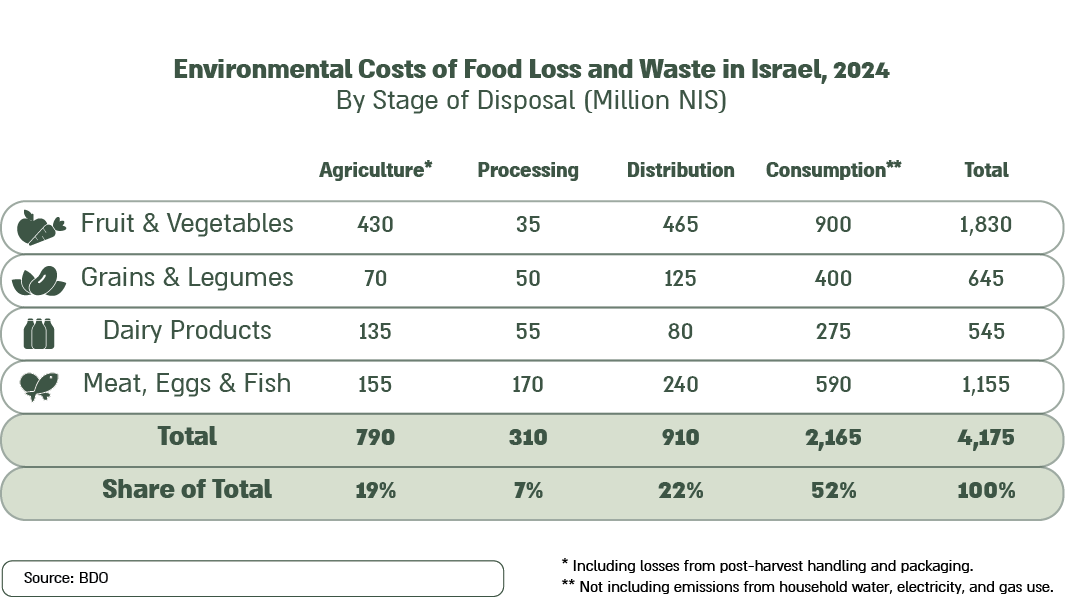
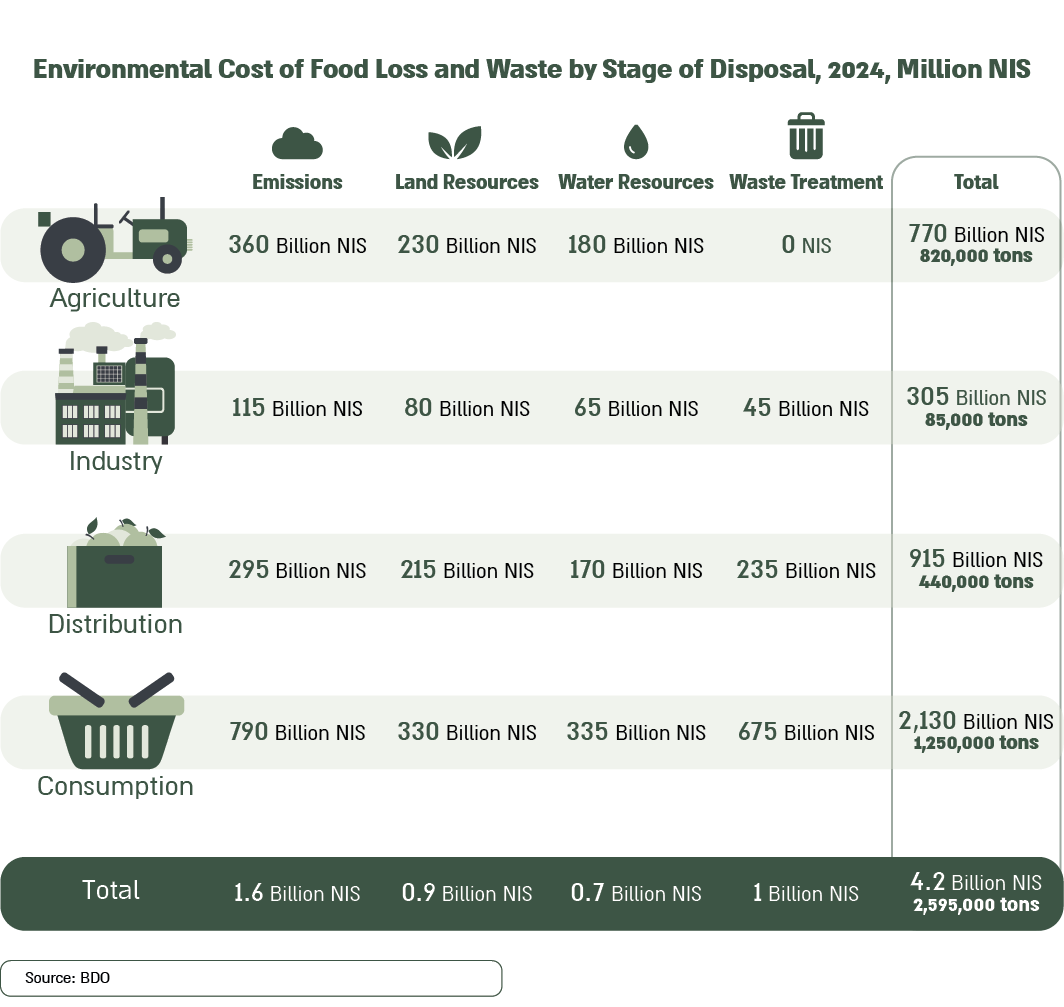
The environmental impacts associated with agricultural produce are assessed across the product’s entire life cycle, from production and post-harvest handling to storage, processing, distribution, consumption, and disposal. The later in the process food is lost or discarded, the greater its environmental impact. This is because the environmental footprint of food waste is shaped by three combined factors: the stage in the value chain where the food is discarded, the environmental effects of its end-of-life treatment as waste, and the cumulative impacts of all preceding stages. For example, when food is thrown away at a grocery store, it carries the environmental burden of every stage that came before: emissions from its cultivation and harvesting, transportation from the field to the packing house and store, and energy used for refrigeration, lighting, and air conditioning to keep it fresh. These are compounded by the emissions generated from transporting the discarded food to landfills and its decomposition after disposal.
Food waste at the consumption stage accounts for about 50% of the total environmental costs of food loss in Israel. When consumers discard food, they are not only wasting the product itself but also all the environmental resources invested in its production, processing, transportation, and distribution up to that point. In 2024, food discarded at the consumption stage[1] amounted to approximately 1.4m tons (including packaging), with an estimated market value of NIS 14b (USD $3.78b). Beyond the cost of wasted food, additional economic damage arises from waste treatment costs, which consumers indirectly pay through municipal fees, totaling approximately NIS 0.6b (USD $162m). Additional environmental damage caused by greenhouse gas emissions and air pollution from food waste at this stage is estimated at NIS 0.8b (USD $216m).
Approximately 60% of total environmental impact originates in the agricultural stage. Agricultural emissions result from fuel and electricity consumption, fertilizer use, sludge and compost application, water desalination, and direct emissions from livestock. This stage also involves extensive use of water and land for food production.
[1] Includes both household and institutional consumption.
An analysis of the environmental impact of different food categories reveals that animal-based food has the highest environmental impact. Food waste from meat, eggs, and fish discarded at the agricultural stage incurs an environmental cost of NIS 5.90 (USD $1.59) per kg due to air pollution and greenhouse gas emissions. If discarded at the consumption stage, this cost rises to NIS 8.20 (USD $2.22) per kg. For dairy products, the environmental cost of waste is NIS 2.3 (USD $0.62) 0 per kg at the agricultural stage, increasing to NIS 2.90 (USD $0.78) per kg if discarded by consumers. Fruit and vegetables lost in the field carry an environmental cost of NIS 0.90 (USD $0.24) per kg, which nearly doubles if discarded by consumers.
The sources of environmental costs vary by food type. For meat, eggs, and fish, about half of the environmental cost comes from natural resource depletion. For dairy products, the primary cost driver is greenhouse gas emissions and air pollution. In contrast, for fruit and vegetables, the cost is evenly distributed between waste treatment, natural resource loss, and emissions.
Greenhouse Gas Emissions from Food Loss and Waste Worldwide
According to UN estimates (2024), global food loss and waste totals around 1.7b tons per year, including approximately 1.05b tons wasted at the consumption stage. The production and cultivation of food that is never consumed generate an estimated 4.3b tons of greenhouse gas emissions annually. This figure includes emissions produced at every stage of food cultivation and production, as well as those associated with food disposal and waste treatment.[1] The global environmental cost of these emissions is valued at roughly $515b per year.[2] This cost varies across regions depending on local conditions, agricultural practices, and the types of crops produced.
In Israel, the production and cultivation of food that is never consumed generate about 5m tons of greenhouse gas emissions, accounting for about 6% of the country’s annual greenhouse gas emissions.